
Helena College Hosts Two-Week “Humanities Through Film” Workshop
Instructor Dru Carr
When Helena College staff read the National Endowment for the Humanities Notice of Funding Opportunity for Humanities Initiatives at Community Colleges, it seemed that the stars were aligned for the college to pursue this grant. New “Guided Pathways” included communications, humanities and fine arts; co-admissions agreements had been negotiated with liberal arts colleges; a film producer/ humanities professor, Dr. Ari Laskin, had been hired to document student stories; the Montana Historical Society’s role was expanding; and MAPS Media Institute had begun offering programming in Helena.
The three-year NEH-funded program, A Bridge to Humanities Pathways in College: Using Film Production to Explore Local Culture and History, is designed as a summer bridge program for high school and early college students to explore the culture and history of their communities, share their research by producing a documentary film and ultimately enroll in college coursework in the humanities. Each year focuses on an important cultural/historical theme. This year, the theme is “Pandemics Then and Now, the Spanish Flu and COVID-19.”
On Aug. 9, 13 students began their exploration of the humanities with a workshop on “Creativity and Methods of Making,” presented by art instructor Seth Roby. Students played games that tested their problem solving, observational, teamwork and interpretive skills, and the boundaries of creativity.
On day two, writing instructor Virginia Reeves led students through exercises on story, cultural and personal bias, and elements of an effective narrative. Dr. Laskin introduced students to the formal elements of film and the five basic types of documentaries, showing students examples of each. By the end of the second day, students had been assigned to their departments: writers/directors, producers, camera, sound and editing.
The third humanities instructor, Kim Feig, used exercises with close readings of late 19th-century texts, employing intertextual analysis to explore how knowledge is produced. The humanities instructors, readings and many of the sample films touched on topics of the Spanish flu or COVID-19.
As students watched and analyzed additional samples of documentary films, they began to formulate a storyboard to plan their film. On their fourth day, students split into two groups that walked to the Montana Historical Society, where they began combing archives, including 1919- 1920 yearbooks, audio tapes, newspapers and other records.
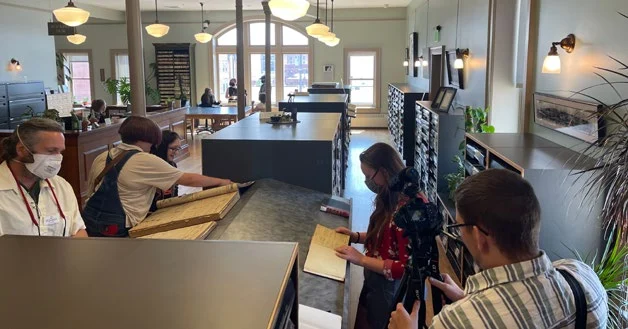
According to one student, the trip to Butte on Friday of the first week was “epic.” At the Butte Historical Archives, students paged through old death records and newspaper articles as cameras and sound equipment recorded the research experience and captured historical documents. MAPS instructor Dru Carr joined the team for filming.
On Monday, working in the computer lab with the first minutes of film and sound, the editing team began selecting footage that would make it to the rough cut. In the other room, students prepared for afternoon interviews with Montana Department of Public Health leaders Greg Holzman, MD, state medical officer during the height of COVID-19 in 2020 and Todd Harwell, administrator of the Public Health and Safety Division. MAPS instructor Cove Jasmin, who specializes in sound, had arrived, but adapting to new sound equipment delayed the start time. Since students were learning how to set up cameras and sound equipment as they set up the interviews, the process appeared chaotic; nonetheless, directors were pleased by the footage.
With only four days remaining, the students would face a tight schedule to finish gathering content, record voice-overs, complete their camera work and put together a rough cut of the film. After debriefing the interviews, one group reviewed footage and sound in the editing room, and another listed the archival documents that they would need to tell their story. During the previous week’s storyboarding activity, they had planned to begin the film with a roundtable in which students would share their own COVID experiences. However, after further discussions about the effectiveness of that approach, they decided to use three individual student interviews to capture those experiences, solving film and sound issues in setting up that scenario.
Since the high school across the street would provide visual interest to a personal story, preparations were made for filming at another site. On Wednesday, the editing team was working furiously to piece together shots and sound for the rough cut as another group went to Helena High School to shoot more scenes. On Thursday, one group began planning and recording a podcast-style sound track to describe their research, what they learned, how they made the film and their “aha!” moments in interview form.
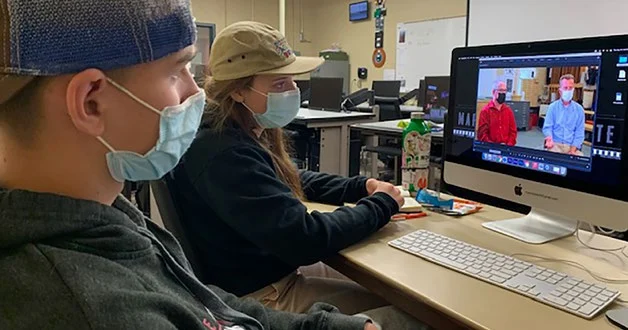
The team of editors had expanded into three groups, working on iMacs for different segments of the film, selecting and organizing scenes, adding voice-overs and discussing possible music backgrounds. They debated the order of shots that would establish a style, pace and overall feel of the film, and how to cut from still to live-action, appropriate transitions and using the camera sound versus sound recorded with their specialized equipment. Huddled around their computer screens with headphones, the students concentrated as they repeatedly viewed certain segments to select the ideal time to cut.
During the podcast taping, one student responded that she had learned: “History is a lot of interpretation of events. It was great to be in a class where you had deep talks about history, not just memorizing dates and places. The humanities—history follows us everywhere. It isn’t just about the past. And then there was the togetherness—coming up with ideas and then having to kill one! This has enhanced my knowledge of history and I realize what is important to me. …Parts of history we forget, then it comes up and it’s comforting to know that we’re not the only ones to experience this.”
During the afternoon of their final Friday, students were delighted to watch the 30-minute rough cut of their film, slated for completion Sept. 20. After working for two weeks, they burst into applause as the film ended. The final film will be screened at the Myrna Loy in Helena on Tuesday, Oct. 12 at 7:00 p.m.
Check out the student podcast for this project: https://soundcloud.com/user-703218914/la-grippe-podcast